
An interview with Lourain Alhalabi
Prepared by: Douri’s Empowering Creative Minds team
Edited by: Jang Kapgen
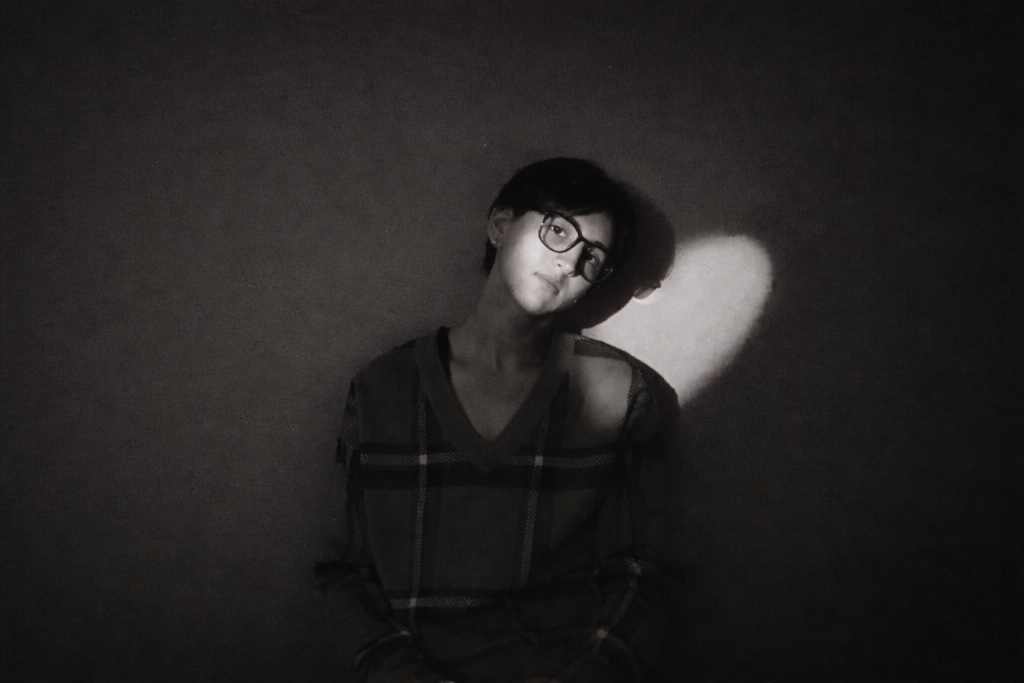
Lourain Alhalabi is a young artist whose art is deeply inspired by her lived experiences. As a Syrian refugee, Alhalabi processes and shares her life back in Syria, as well as her journey to and now her experiences in Luxembourg through her art. The artist’s multimedia pieces reflect honest and vulnerable accounts of the human experience. As part of the Empowering Creative Minds project, Douri asbl spoke to Alhalabi about her artistic practice, her background, and what sharing her art means to her.
Douri: What key milestones have shaped your creative journey from the beginning until now?
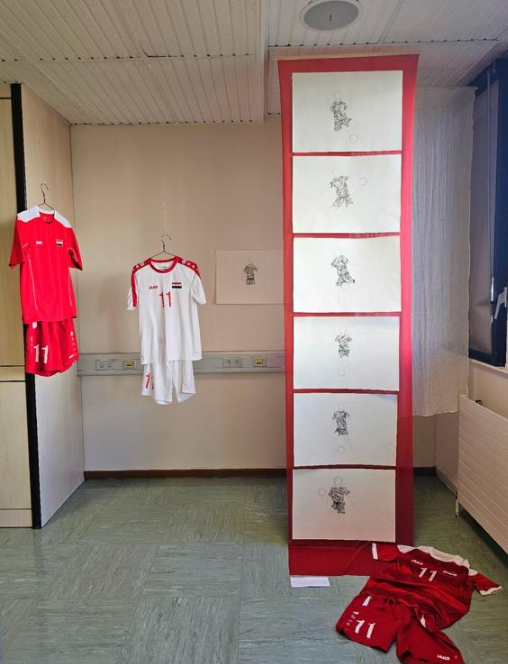
Lourain Alhalabi: I ran out of Syria after the war had started in 2018 and this moment deeply shaped my identity. Therefore, my art has been influenced by my experience and memories of my journey as a refugee passing through Iran, Turkey, and Greece to come to Luxembourg. At the time, I was 13 years old and at the peak of my football career. I had just come back from the “WAFF U17 Girls Championship” that took place in the UAE, so leaving my passion, home and family behind wasn’t easy for me. Thankfully, my life changed for the better here in Luxembourg, however things moved very fast for me and, as I was surrounded by people who took the same road as me, I didn’t have my time to process what I went through and I always felt that it wasn’t even a big deal. But in the back of my mind, I still needed to face these changes, to stop being worried about how people would consider you differently as a refugee and to say proudly “yes, I’m a Syrian refugee and I survived this and this…”
In what ways have your upbringing and personal experiences influenced your artistic direction?
As these moments became part of me, I used my art in the aim of telling my story to put the refugee crisis in the spotlight. It basically shaped all my art works and the cause I want to support.
Have you found that challenging experiences — whether personal or societal — have impacted your creative process or influenced your artistic path?
Definitely. For me it wasn’t even controllable. Each time I tried to draw or think about a topic that interested me for a future project, I came back to the same ideas. I had a story that was untold and I couldn’t let it go. So everytime I start brainstorming and my attention immediately goes to the refugee cries in the Middle East, then to the horrible treatment people have to go through after running away from the war and poverty, to take me back to the time it was me on the road with my family. I felt as if it was my role to tell that story to show people what my family and I and millions of people had to live through to come to this comfortable life in Luxembourg.
How has your creative practice helped you process or move through difficult experiences?
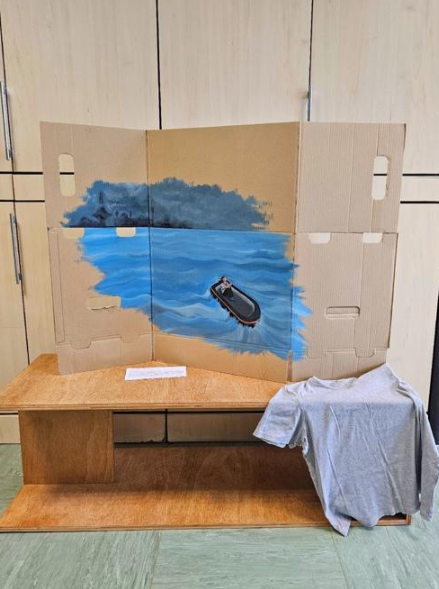
In the beginning I didn’t consider art to be my way to process my experience, however it came naturally later on. When I finished a drawing or a sculpture, I felt less pressure as if it wasn’t up to me anymore to tell the story, it was for the person watching to retrace it. For example, in my work named “Drifting away”, I represented our passage from Turkey to Greece, which is the time that affected me the most. While making this painting I remembered every detail and emotions I felt at the time and that was my opportunity to give myself the time I didn’t have and the courage I needed to help me to move on.
Do you believe that art can express emotions and experiences that are hard to articulate in words?
Yeah, for me it was the case. Some things were just so hard to tell for some reason. Maybe it’s because I felt afraid of being sad or because sometimes I was so angry I couldn’t change how things were at the time. Art was my way to let my emotions flow as it was meant to be. Moreover, it was my character to hold my feelings in me, but through art I learned to express it. I didn’t feel the need to be perfect or to hold a stable image, instead I dealt with it using different colours and materials.
What are some challenges artists face when expressing personal or traumatic experiences through their work?
I think it’s the feeling of being exposed or feeling afraid to be judged as others enter your private zone. It can be a challenge to reunite all the courage you have for that moment and to face all the second-guessing about whether or not it’s a good idea.
Has your approach to expressing painful or difficult experiences changed over time? If so, how has that evolution taken shape?
As I said, I used to avoid facing what I was going through. I avoided hearing news about my country, talking to my old friends from there, or using facebook as it was the platform they used the most. I think my way was to preoccupy myself with every activity, so I could avoid having time to remember it. I wouldn’t say that my way of having difficult experiences changed by itself, but now I consider that I processed the most painful memories I had. Therefore I have more time to understand how I want to evolve in the future (PS: hopefully I won't have to process something as big anymore 🙂 …).
How do you interpret the term “vulnerable artist” in the context of your own experience?
In my point of view, vulnerable artists are those who dare to show their struggles and expose personal truth about themselves showing how they reacted in different periods of time – did they run away or did they face events with anger ? For me letting people discover my story – but not only me, also of my family – was a big act of vulnerability. At the end, you take a risk as a vulnerable artist, you create and observe all the different ways people could understand your work, some get inspired to reflect on their own stories, but others won't relate to it at all. The vulnerability there is to accept both sides.
What does it mean to you when your art resonates with or impacts others?
At my art exhibition a lot of people became emotional, but one part stayed in my head for a while, which was about a girl who came to see the exhibition the next day with her class. I was told by my teacher that that girl was also a Syrian refugee and once she saw the works she started crying lot. I wasn’t there at that moment, but it meant a lot to me. Weirdly, I felt as if I knew what that girl went through and how she felt at that moment. At that time, I realised what the “power of art” means. I didn’t make my art with the objective of impacting others, but more to liberate me of the weight I’ve been holding, still this made me feel proud and relieved that I was understood and not alone in my thoughts anymore. I also considered this as something that helped me to move on.
In your view, how does the local cultural or societal context influence how you express trauma, or how audiences receive your work?
I believe that it’s crucial. When I try to imagine myself doing this in Syria, I find it way more difficult and complicated. I feel like I wouldn’t have enough courage to share my art in a different context, especially because I would be facing people directly connected to the moments I’m working through, for example: I had this work called “One day…” where I express my feelings after leaving the football team, therefore showing this piece in front of people from that period would have made me feel more vulnerable, even exposed. Maybe I would also have doubted whether my story was something meaningful or worthy to share, as in Syria people go through much worse experiences. I felt that people were more openly sensitive to topics like trauma, loss, or displacement. This gave me the confidence to be more honest in my art, and less afraid of being judged. It became a space where vulnerability was not only accepted, but respected.
How do you see the role of institutions — such as theatres, publishers, galleries, or museums in shaping the landscape of art and creativity?
Unfortunately in our society, it determines a lot. Who gets visibility or not? What stories are considered important and which are not? Etc… I feel like if people get equal opportunity (only through talent, not power) to present their works then this would be of a great help to get visibility, but an artist can make any place their exhibition and present mindblowing artworks. So the place shouldn’t affect our perception of the art itself.
What types of support do you consider essential for sustaining your artistic practice and expanding your social engagement?
I feel like being in a social group full of people who appreciate arts and who would encourage me to continue is essential.
Do you have any messages or recommendations you'd like to share with organizations or institutions that support the arts?
From my point of view as a student art is under appreciated at lot of schools. In my case I was lucky to chose art as an IB student but there was no other class that had “real” art class. That’s why I think it’s important to interfere in earlier stage to make people more sensitive and appreciate more the beauty and the self discovery art bring to the artist.
Do you incorporate practices like meditation or other reflective tools into your creative process?
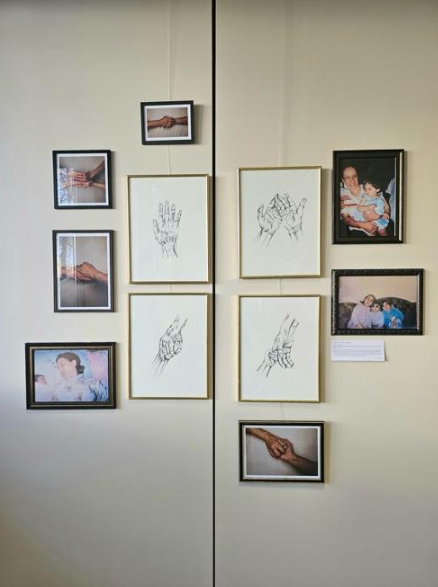
I don’t meditate, but I always look at old pictures to remember certain details for example. Sometimes I recreate these pictures, modify them to turn them into new works or sometimes I just add them in my works as they are. An example could be my work titled “Mama”.
What techniques or tools have you found most effective in exploring complex experiences through your art? Are there any you'd be willing to share or teach—whether to fellow artists or the public?
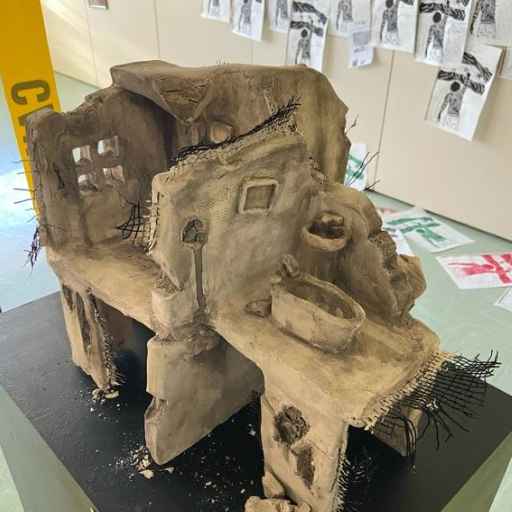
Techniques and tools vary a lot depending on the intention of the artist, therefore this would vary if the topic I presented was also different – but I found that sculpture with clay was the best way (but also my favorite way) to recreate some parts of my stories. I loved the imperfections of it and how it just all became a meaningful part of the story, once the work was done. The material itself sometimes behaved in an unexpected way which I could use in my interest. For example, in the sculpture called “Leftover”, I mixed clay with different types of wires. The result after taking it from the oven was unexpected. The sculpture broke or cracked in some places I didn’t consider but I found it very interesting afterwards.
How do you view the role of technology and social media in sharing your work and expanding engagement with the issues you explore?
In my case, I found it important. When I was confronted with the idea, I thought it might inspire someone else to start expressing their ideas or encourage other people to be proud and open about their history. I still believe that an artist doesn’t necessarily need technology to share their ideas, although it is easier through social media and interestingly helpful. For me, my exhibition was also a sort of reminder to people to reconsider what happened in the Syrian war and how it affected the people. Therefore, posting on instagram reunited me with people who shared my beliefs about the importance of my issue.
Are there any current or upcoming projects you’re excited about?
I don’t have any specific plans for the future but I hope to start using my art in the aim of supporting humanitarian causes. I’m also curious which way it would take me 🙂
Thank you Lourain Alhalabi for this interview.
The Empowering Creative Minds project is funded by the EU Creative Europe Programme, supporting cross-cultural collaboration and artistic growth across Europe.
